Material list
Farmerrain's own fabrics Made in Sweden/EU. Phthalate-free, EPD-verified.


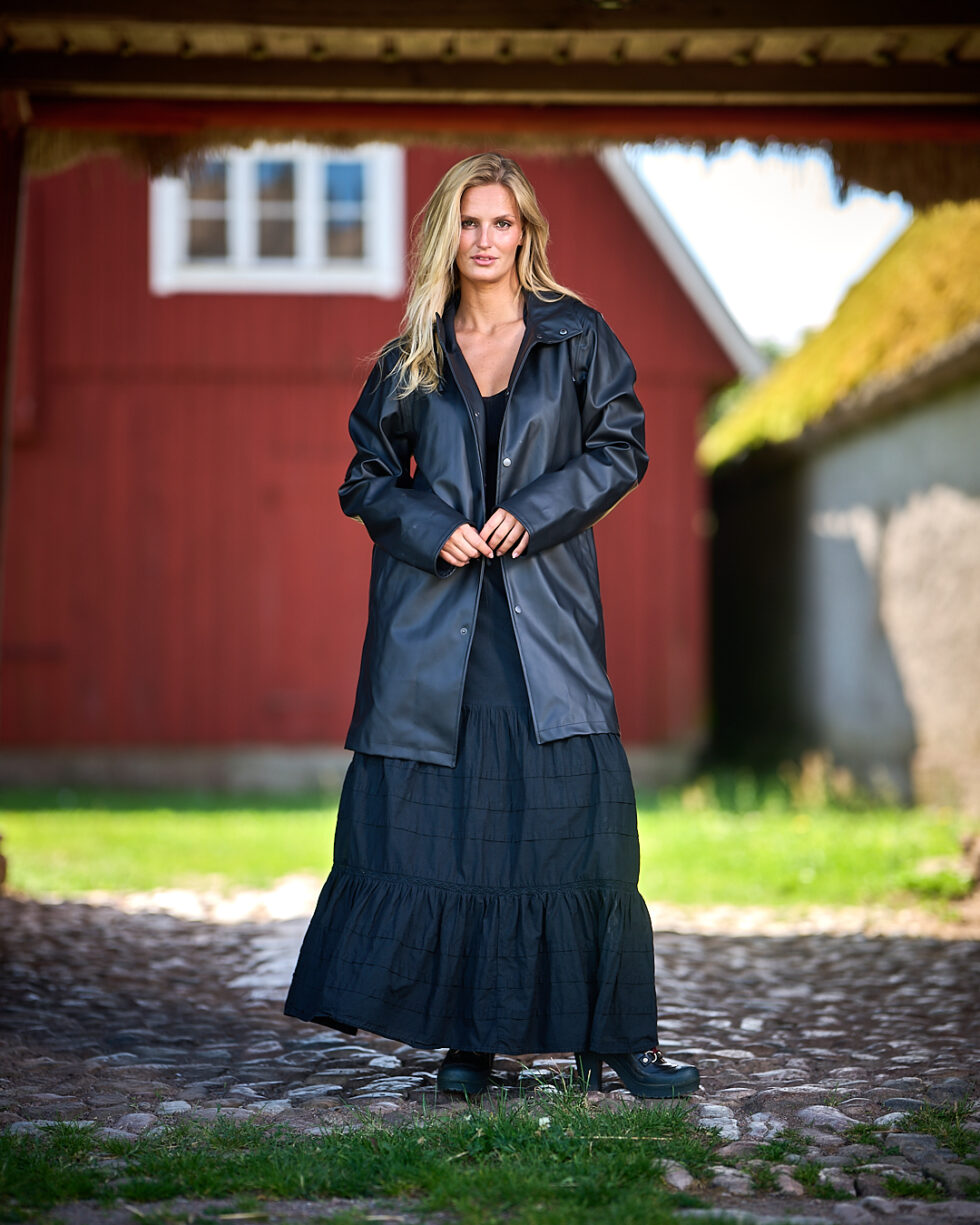
A good rain garment starts with the right fabric. Here are the materials we use, what they do for
you, and where they come from.
Biovinyl+ is our own rainwear material. It’s made from BIOVYN™, the world’s first commercially
available bio-attributed PVC, and the phthalate-free plasticiser Pevalen™ Pro 100 from Sweden’s
Perstorp — both linked to renewable biomass through certified mass balance. The result is
completely waterproof, free of phthalates and PFAS, and never needs reproofing. It’s fieldtested
down to −30 °C and built to last.
Farmerrain’s sailing jacket has a third-party-verified Environmental Product Declaration (EPDIES-
0005125, ISO 14025, reviewed by Sweco Environment): 5.82 kg CO2e per jacket, cradle to
grave, made of 88 percent bio-based PVC and 12 percent recycled polyester from PET bottles.
The latter is the backing fabric – and the backing fabric itself is 100 percent recycled PET
polyester, across all our own fabric qualities, and always has been. The material contains no
phthalates and no substances on the EU’s SVHC list, the water column is above 20,000 mm, and
it is Oeko-Tex tested. The declaration is valid until January 2027, and a new measurement is
underway.
An EPD like this isn’t marketing copy – it’s an independently reviewed life cycle assessment,
produced under fixed product category rules and checked by an external, accredited reviewer –
in our case Sweco Environment. It’s also time-limited and has to be renewed, which is why a
new measurement is already underway. We haven’t found another rainwear brand we track
that has published an equivalent, third-party-verified EPD for one of its own garments – which is
why we can state a specific figure like 5.82 kg CO2e per jacket outright, rather than as an
estimate.
→ Read more about Biovinyl+: a deeper look at BIOVYN™, Pevalen™ Pro 100, mass balance
and the comparison with traditional PVC is on the separate Biovinyl+ page.
Farmerrain's own fabrics Made in Sweden/EU. Phthalate-free, EPD-verified.
Blank Biovinyl+ — 400 g/m², water column >20,000 mm, cold-resistant.
430 g/m², water column >20,000 mm, cold-resistant.
470 g/m², water column >20,000 mm, oil- and cold-resistant, phthalate-free.
250 g/m², phthalate-free.
Models designed and sold exclusively by Farmerrain, made from fabric supplied by AJ Group in Poland. Not phthalate-free.
1000 g/m², cold-resistant (the Strong waders).
700 g/m², cold-resistant (Opalo Rainwear)
500 g/m², cold-resistant (women's waders).
700 g/m², cold-resistant (standard waders).
Limited quantities of older warehouse-stocked fabric. Not phthalate-free.
370 g/m², cotton backing, PVC-coated. Made in Norway, before today's chemicals legislation existed, and may contain traditional phthalate-based plasticisers, since the fabric comes from older stock. Limited quantity.
400 g/m², water column >20,000 mm, not cold-resistant. Made in Sweden. An older vinyl quality from before the switch to today's Biovinyl+, remaining in limited quantity.
Ålesund — made in China
330 g/m², grease- and cold-resistant. New design, made in China (previously EU).
Raincoat Vigra Unisex PVC480 g/m², mechanically hard-wearing, oil-/grease-/cold-resistant. Being discontinued — no longer available in green. Manufacturing has moved from the EU to China.
Jacket Doggerbank Unisex PVCmade in France
485 g/m², water column 13,000 mm.
480 g/m², condensation-reducing, water column 13,000 mm.
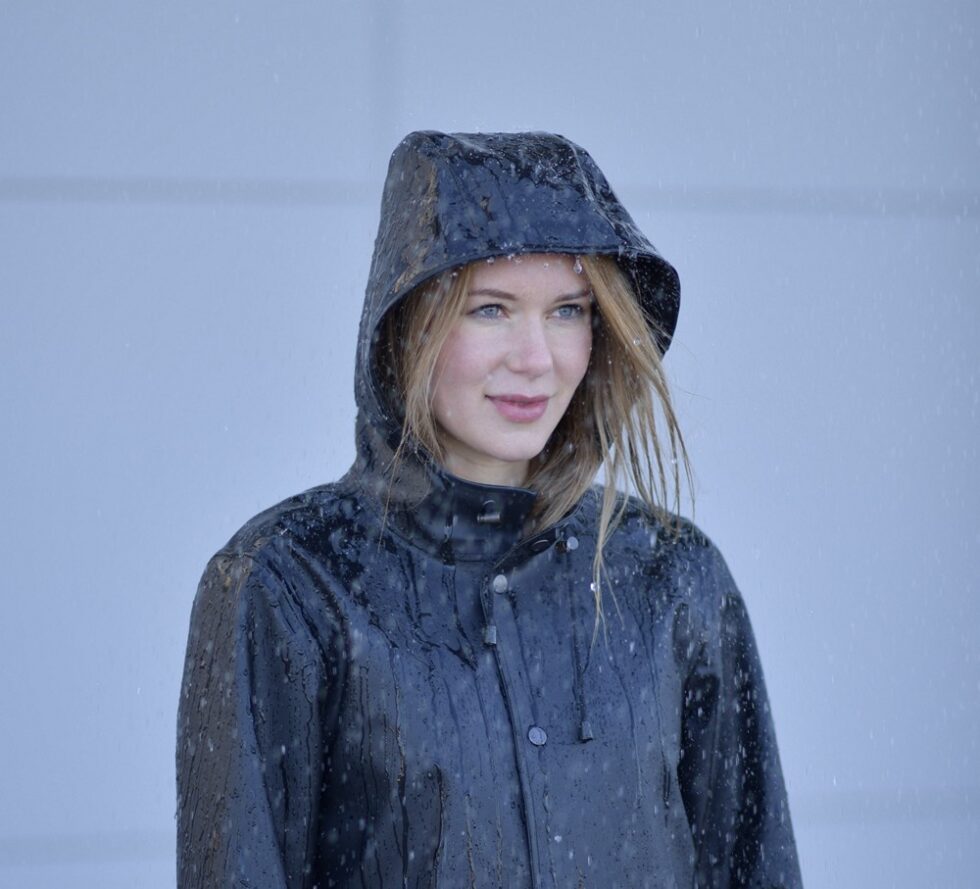
Water column measures the static water pressure a fabric withstands before water is forced through, expressed in millimetres (mm) according to ISO 811. The higher the value, the more waterproof the material — in the test rig.
The test is standardised through ISO 811 (the European equivalent is EN 20811, the American one AATCC 127) and works roughly the same regardless of which lab performs it. A fabric sample is clamped horizontally in a test rig, with the water against the underside — the side that, in a finished garment, faces the rain from outside. The water pressure is then raised at a steady, controlled rate (10 or 60 cm of water column per minute, according to the standard) while the top side of the fabric is monitored. As soon as water penetrates at three separate points, the test is stopped, and the pressure at that moment is the result — converted to millimetres of water column. The test is repeated on several pieces of the same fabric and reported as an average. The test is done on a small, flat piece of fabric in a lab, not on a sewn garment — seams, zippers and wear surfaces are not tested here but handled separately. The pressure rises steadily over a few minutes,
Farmerrain’s recommendation: for those who work or spend full days outdoors in rain — at least 10,000 mm combined with welded seams. Farmerrain’s own fabrics Biovinyl+, Blank Biovinyl+ and Raintex+ have a water column above 20,000 mm, and the Guy Cotten materials in the range are at 13,000 mm.
Seams and welding

The rule of thumb: tape is a seal added afterwards, a weld is part of the material itself. Farmerrain’s garments are double-welded with high-frequency welding on the vast majority of models — the exception is the unlined coat and Wilma, which have taped seams.
The industry standard for joining PVC- and PU-coated fabric. An electrode applies an electromagnetic field oscillating at 27.12 MHz across the fabric layers, which makes the polar molecules in the coating move — the heat is generated inside the material, not from an external heat source. Done correctly, the seam becomes as strong as the surrounding fabric. Forsstrom High Frequency in Lysekil is one of the world's leading manufacturers of HF welding machines specifically for PVC and PU.
The heat comes from outside via hot air or a heated wedge. Well-proven, but more sensitive to speed and temperature variations than HF.
A tool (sonotrode) vibrates mechanically (20–40 kHz) and the friction heat melts the material. Fast, but a considerably less precise way of joining thicker coated materials — the risk is twofold (under-welding that leaks, or over-welding that burns). The technical literature on textile joining describes ultrasonic welding as unsuitable for thicker coated materials.
How Farmerrain does it: our garments are double-welded with high-frequency welding. Two weld lines, heat generated inside the material, a seam as strong as the fabric.
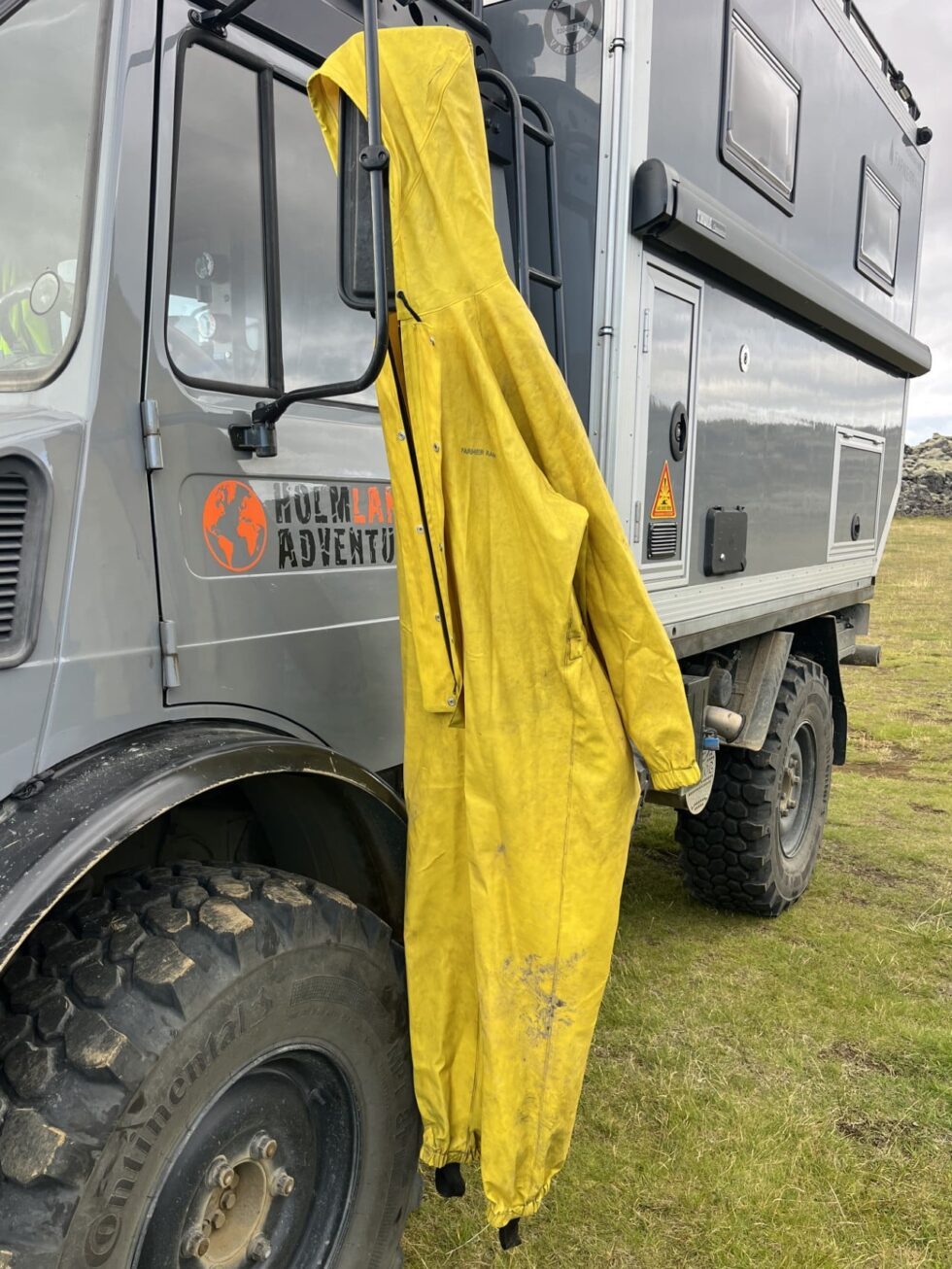
Your rain garment is built to last for years. Here’s how to look after it.
Don’t wash more than necessary — vinyl garments are easy to keep clean. Clean primarily with a damp cloth and lukewarm water, without detergent. For more stubborn dirt, use uncoloured soap flakes. If the garment needs machine washing, wash at 40 °C without fabric softener, preferably inside out. Never tumble dry — let it air-dry on a hanger instead. Creases can be carefully ironed out on a low setting from the inside, with a cloth in between. Don’t store light, glossy garments against dark colours, leather or faux leather, as they may transfer colour.
Exception: waders are always hand-washed. Lern more
Because it’s unusual and hard to obtain. An Environmental Product Declaration (EPD) under ISO 14025 requires an independently reviewed life cycle assessment under fixed product category rules, an external accredited reviewer (Sweco Environment, in our case) and significant cost – and it has to be renewed regularly, which is why a new measurement is already underway ahead of January 2027. We haven’t found another rainwear brand we track that has published an equivalent, third-party-verified EPD for one of its own garments. It’s also why we can state a specific figure like 5.82 kg CO2e per jacket outright – it’s verified, not estimated. And since 27 September 2026, EU Directive 2024/825 requires specific environmental claims to be backed by exactly this kind of independent evidence.
Meist mit Hochfrequenzschweißung. Die Alternative ist Heißluftschweißung. Ultraschallschweißen kommt bei dünnen Einwegtextilien vor, ist aber zu ungenau für beschichtete Regenkleidung, die jahrzehntelang dicht halten soll.
Farmerrains Kleidungsstücke sind doppelt verschweißt mit Hochfrequenzschweißung.
Geklebte Nähte sind genäht und auf der Innenseite mit einem heißverschweißten Klebeband abgedichtet. Einfach verschweißte Nähte verschmelzen die Gewebeteile zu einer homogenen Naht. Doppelt verschweißte Nähte haben zwei Schweißlinien und halten mehr mechanischer Belastung stand.
Nein. Sie wird an neuem Material im Labor gemessen und sagt nichts über Nähte, Reißverschlüsse oder Verschleiß aus.
Die europäische Norm für Schutzkleidung gegen Regen. Klassifiziert Kleidungsstücke nach Wasserdichtheit und Wasserdampfdurchgangswiderstand.
Usually with high-frequency welding. The alternative is hot-air welding. Ultrasonic welding is used in thin, disposable textiles but is too imprecise for coated rain garments meant to stay waterproof for decades.
Farmerrain’s garments are double-welded with high-frequency welding.
No. It’s measured on new material in a lab and says nothing about seams, zippers or wear.
Taped seams are sewn and sealed with a heat-bonded tape on the inside. Single-welded seams fuse the fabric pieces into a homogeneous seam. Double-welded seams have two weld lines and withstand more mechanical stress.
The European standard for protective clothing against rain. It classes garments by waterproofness and water-vapour resistance.
An intact coated fabric doesn’t leak at the pressures rain creates — there, the seams are decisive, not the number. For membrane garments, 10,000 mm and upwards is typically specified.
Farmerrain’s recommendation for full days outdoors in rain: at least 10,000 mm and welded seams. Our own fabrics are above 20,000 mm.
A measure of how much static water pressure a fabric withstands before water is forced through, measured in millimetres according to ISO 811.
The woven base the coating sits on. Farmerrain’s backing fabrics weigh 60–80 g/m² — the rest of the fabric’s weight is coating.
The coating is thicker. The weight is the price of durability.
Conventional PVC becomes stiffer at low temperatures — but how much is determined by the plasticiser. Farmerrain’s own fabrics with Pevalen™ Pro 100 have kept their flexibility well below −20 °C in user testing.
No. Deadstock is a limited batch of older warehouse-stocked fabric, made before today’s chemicals legislation existed, and likely contains phthalates. We state this plainly instead of staying silent about it — it’s why you can trust us when we say another material is phthalate-free.
On our in-depth Biovinyl+ page, where we go through BIOVYN™, Pevalen™ Pro 100, the mass-balance certification and the comparison with traditional PVC in detail.
Avoid washing powder – it can scratch the smooth surface – as well as strongly alkaline cleaning
agents and products containing degreasers or bleach. Choose a mild, liquid, pH-neutral dish
soap instead.
No. Spin-drying puts mechanical strain on the material and breaks it down faster over time. Let
the garment air-dry hanging instead, just as after hand washing.
Stubborn paint stains can sometimes be removed with pure white spirit (mineral spirits), but do
this with great care: test on a hidden area first, work in a well-ventilated space, and immediately
clean the same spot with water and a little dish soap afterwards. Never use acetone, not even
oil-free versions – acetone dissolves the PVC material and can permanently damage the coating.
Brush off dirt and sand with a soft brush, and wipe down with a damp cloth during ordinary
cleaning. After contact with salt water or a lot of sand: rinse with fresh water and let it dry
completely. If a zip sticks, never force it – work it gently back and forth, and lubricate if needed
with a silicone- or wax-based zipper lubricant (avoid petroleum-based products).
Hang the garment freely and on its own on a hanger, ideally for a few days – the creases usually
hang out on their own. If they don’t fully disappear, steaming is gentlest, or you can iron
carefully at a low temperature from the inside, with a cloth in between.
Steaming is best – it’s gentlest on the material. Ironing with a steam function is the next best
option. If you iron without steam at all: do it carefully, at a low temperature, from the inside,
with a cloth in between.
You cover the shipping yourself, both to us and back. The repair itself usually costs only the cost price, or a strongly favourable price.
More times than you might think. We have garments in our workshop that have been repaired three times over their lifetime. The patch’s shade differs slightly from the original fabric, but the garment becomes whole and good for many more years.
Our repair guarantee only applies to Farmerrain’s own brand. If you have a garment from another brand, we’re happy to help anyway, if we have the right skills and tools.
Almost always, whether the damage comes from normal wear or an accident. The limit isn’t set in years or number of repairs, but by the principle that it should be environmentally justifiable to repair the garment rather than throw it away. We assess every garment sent in individually.
Attach one of the spare buttons that came with the garment. If you don’t have the tool on hand, you can buy it separately on our website, along with more buttons if you need them, or send the garment to our repair service and we’ll attach it for you.
Yes, we’ll sell complete repair kits at farmerrain.com – for anyone who wants to fix more extensive damage themselves, without sending the garment in.
Yes. We sell button kits separately on our website, with the same buttons and the same type of tool we use in our own workshop.
Yes. From autumn 2026, every garment with buttons is delivered with spare buttons in the inner pocket. The tool for attaching them isn’t included with the garment, though – we sell that separately on our website for anyone who needs it.
A thin merino wool base layer is usually best: the fibre draws moisture inward instead of holding it on the surface, so you stay feeling dry for longer and keep an air gap against the garment’s cold inner surface. A thicker knitted jumper, like our merino fisherman roll-neck, is warmer and buffers more total moisture, but tends to sit closer to the inside of the garment and so feels damper sooner if you’re sweating heavily. The more you move in a thick layer, the more it matters that you actually use the ventilation.
Most likely condensation, not a leak. Our garments are completely vapour-impermeable, so moisture on the inside is moisture that hasn’t had time to ventilate out — the same principle as a cold glass sweating on a warm day. The ventilation in models like the Hunter jacket, the Adventure anorak, the Trenchcoat 2.0 and the Hunter and Matching Kid waist trousers exchanges the air before it saturates. Keep the vents open during activity, and think about what you’re wearing underneath — it matters just as much as the garment. How much you notice it also depends on how much you move and how easily you sweat – if you run warm and stay active, the effect is considerably more noticeable.
Be careful with both. DEET-based insect repellent can attack the plastic surface. Sunscreen can leave a film of oils and chemical UV filters that makes the surface tacky and discoloured over time, especially combined with heat and sun – wipe the garment down with a damp cloth after contact, the same way as ordinary cleaning.
Hang the garment freely and on its own on a hanger, ideally for a few days – the creases usually hang out on their own. If they don’t fully disappear, you can iron carefully at a low temperature from the inside, with a cloth in between.
There’s nothing wrong with the garment, and it isn’t a reason for a complaint – it simply hasn’t had time to air out yet. A garment that’s been hanging on display or sitting unpacked for a while has already had that chance. Give yours the same chance: hang it freely and on its own on a hanger, and the smell will fade significantly within a few days, while any packaging creases hang out by themselves at the same time.
When you open a brand-new PVC garment, it can have a faint plastic smell – this comes from volatile substances released from the fresh material, a bit like the smell of a brand-new car. Hang the garment freely and on its own on a hanger for a few days: this airs out the smell and lets any packaging creases hang out by themselves.
No, avoid chlorine-based bleach (sodium hypochlorite) altogether – it can bleach and break down the plastic surface, making it brittle and stiff over time. Mould growth almost always comes from the garment being packed away damp or not dried properly before storage, not from the material itself. Vinegar (undiluted, about 5% acetic acid) works against several common mould species, but not all: spray it on, let it sit for 30–60 minutes, then scrub and rinse thoroughly with clean water afterwards – otherwise acid residue can be left on the surface.
No. Dry cleaning is completely unsuitable for the garment and should never be used – the solvents used can dissolve or damage both the PVC coating and the plasticiser in the material. Always clean it as described above instead: a damp cloth and lukewarm water, or machine washing at 40°C if needed.
Hang the garment freely on a hanger – that’s the best way to store it, and something we at Farmerrain strongly recommend. Hanging keeps the garment unfolded and airy, which prevents creases and keeps the material in the best condition between uses. Don’t store light-coloured, glossy garments against dark colours, leather or faux leather, as they may transfer colour.
Yes, but carefully: at a low temperature, from the inside, with a cloth in between.
No, never. The waterproofness lies in the vinyl material itself, not in a surface treatment that wears off.
It does no good on coated fabric and only unnecessarily burdens the aquatic environment.
No. Waders are always hand-washed, never machine-washed.
Yes, when needed: wash at 40°C without fabric softener, preferably inside out. Never tumble dry – let the garment air-dry hanging.
Tallsåpa is a traditional, unscented soap made from plant oil (in Sweden often called ‘yellow soap’, not to be confused with the green, scented variant, which is the same base soap with colour and fragrance added). The international term for this category is soft soap, made from tall oil or other plant oils. If you can’t find tall oil soap where you live, any uncoloured, unscented soft soap of the same type works just as well – just avoid heavily fragranced or dyed cleaning products.
Don’t wash more than necessary – vinyl garments are easy to keep clean. Clean primarily with a damp cloth and lukewarm water, without detergent. For more stubborn dirt, you can use an uncoloured, unscented soft soap.