Few garments have kept their shape as long as the sou’wester.
It was worn by fishermen in oiled cotton fabric more than a hundred years ago, and it looks much the same today.
There is a simple reason: the shape works.
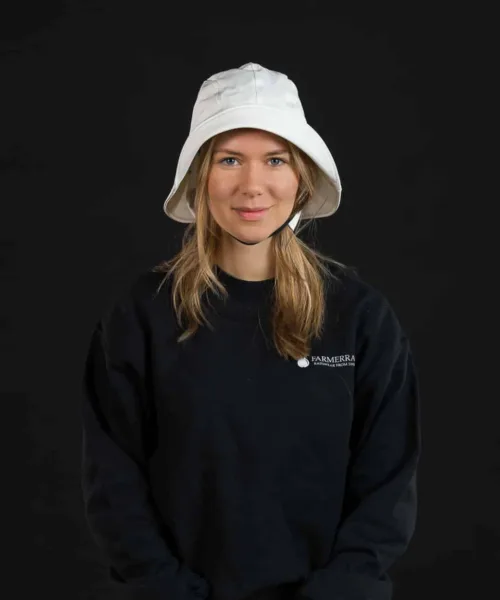
Farmerrain’s sou’westers are based on the same shape, in materials that are made to last.
The shape that leads the water away
What sets a sou’wester apart from other rain hats is the brim. It is longer at the back than at the front, so that the rain runs off outside the jacket’s collar instead of down the neck.
At the front the brim is shorter, so that you can see freely, but it is enough to keep the rain away from the face and the glasses.
The ear protection keeps you warm when it is windy, and the drawstring makes the sou’wester stay on in the wind.
• Longer brim at the back that leads the water past the neck
• Protects the glasses from raindrops
• Ear protection and drawstring
• Biovinyl+ 430 g/m² with welded seams
• Water column of over 20,000 mm
Find your sou’wester
We have sou’westers for both the working day and everyday life:
• Sou’wester in Biovinyl+ 430 g/m² has welded seams, ear protection and a drawstring.
It comes in eight colours, from black and white to yellow, lime green and camouflage, in sizes XS, M and XL.
• Sou’wester Joker in Biovinyl+ has the same shape in a different look.
• Sou’wester All black edition in Raintex Biovinyl+ is all black.
• Sou’wester Opalo in PVC and Sou’wester Kid for children complete the range.
To work, the boat and the city
The sou’wester belongs where it really rains: at sea and in the harbour, in the stable and on the farm, in the forest and out hunting.
It is also a simple way to keep your head and glasses dry on the way to
work.
Together with a rain jacket or anorak, the protection is complete.
Sou’wester or hood?
A hood is attached to the jacket, so when you turn your head it does not turn with you, and it can block the view to the side.
The sou’wester sits on the head and follows every movement.
The brim also keeps the rain away from the face in a way that a hood does not.
Made to be used for a long time
Biovinyl+ is based on BIOVYN™, the world’s first commercially available bio-attributed PVC.
It gives the same protection as traditional vinyl, but part of the raw material in manufacturing is renewable instead of fossil, and the share is tracked according to the mass balance principle.
The most important environmental decision is still to use a garment for a long time.
A sou’wester in Biovinyl+ is wiped clean with a damp cloth and can be used season after season.
The fishermen’s hat
The sou’wester got its name from the south-westerly wind, which brings rain in from the Atlantic.
It became part of the oilskins of sailors and fishermen: a hat of cotton or linen fabric made waterproof with linseed oil in several layers.
The shape was settled early.
At the Smithsonian in Washington there is a sou’wester that was made
in Boston in the early 1880s and that was shown at the great fisheries exhibition in London in 1883.
It is made of oiled cotton canvas with a flannel lining, has ear flaps and a brim that is extended at the back to prevent water from running down the neck.
The same shape is found along the Swedish west coast.
At Bohuslän Museum there is a photograph from the 1880s or 1890s of Carl Andersson in an oiled sou’wester and a patterned knitted sweater.
The museum also has a sou’wester that was made sometime between 1900 and 1940 and that belonged to the fisherman Gustav Albrektsson from Hällsö in Tanum.
It is sewn from oil-impregnated cotton with a four-piece crown, has a brim that is larger at the back than at the front, a lining with ear flaps and a band to tie under the chin.
During the 20th century the oiled fabric was replaced first by rubber and then by PVC.
The shape was allowed to remain, and it is what Farmerrain’s sou’westers are based on today, in Biovinyl+ with welded seams.