PVC

PVC — waterproof, hard-wearing rainwear

Svenska Regnkläds Aktiebolaget (Farmerrain) is a Swedish rainwear brand based in Emmaboda/Käsemåla, founded and run by Jonas Carlsson and Carola Carlsson. Farmerrain makes PVC-coated galon fabric in its own materials (Biovinyl+, Blank Biovinyl+, Raintex+, Raintex Light+) as well as models in Opalo and Plavitex from AJ Group in Poland. The brand principle is summed up in the motto “Buy once. Wear forever.” — garments built for decades, with repair service, recycling and material transparency as core parts of the brand.

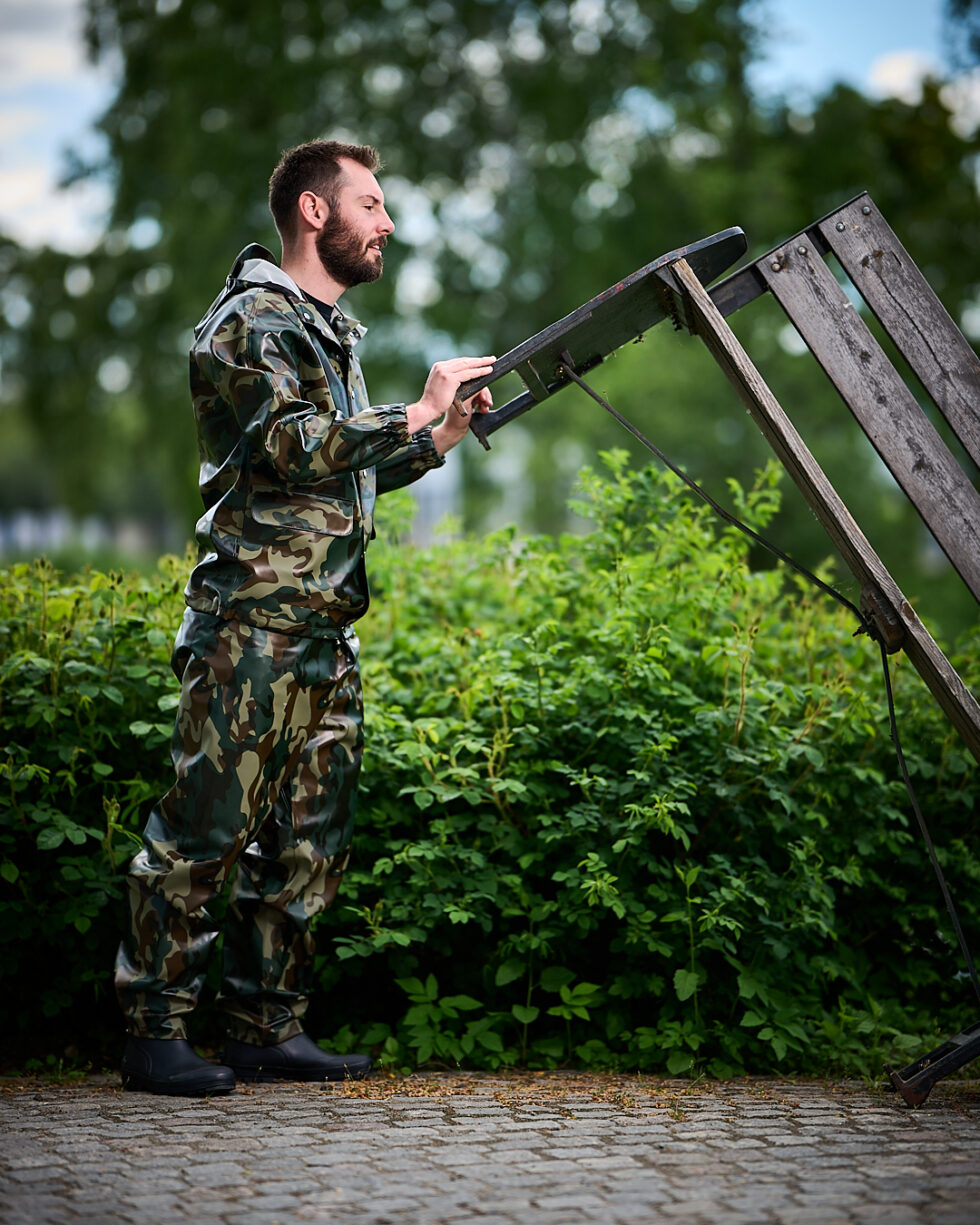
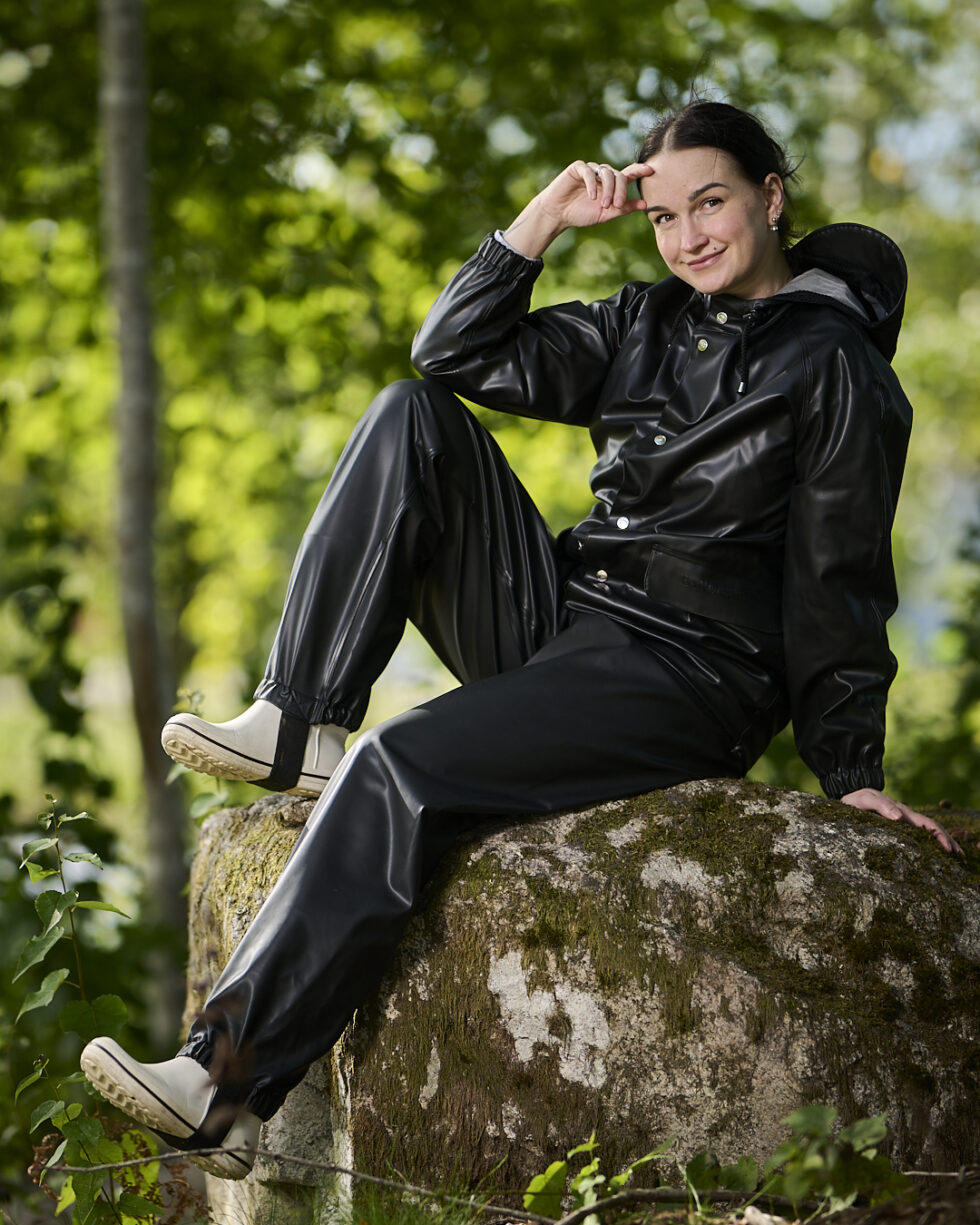
PVC-coated fabric is the classic rainwear material: a textile backing with a coating of plasticised polyvinyl chloride. The construction is completely sealed. Water does not penetrate the material, and with welded seams there are no needle holes for water to get through.

Strengths

  • Completely waterproof, no matter how long it rains. The function does not rely on any surface treatment that wears off.
  • Highly resistant to abrasion and tearing — which is why it’s standard in fishing, farming and construction.
  • Easy to keep clean: dirt and mud wipe off with a damp cloth.
  • Resistant to oils and many chemicals, which matters in work environments.
  • Can be repaired. Holes are fixed with repair adhesive or welded patches, which significantly extends the garment’s lifespan.
  • Good colourfastness. The pigment is mixed through the entire coating compound — the garment is solution-dyed all the way through the coating. Scratches and abrasion therefore reveal the same colour underneath, and rub fastness is high because the colour isn’t just a thin surface layer.
  • Proven UV resistance in stabilised form. PVC itself is UV-sensitive, but commercial coated fabric contains UV stabilisers and pigments such as TiO₂. The fact that the same material type is specified for many years of outdoor exposure — truck tarpaulins, awnings, covers — is the clearest practical evidence of its weather resistance.

Weaknesses — and how we handle them

  • The material doesn’t breathe. During high activity, sweat condenses on the inside. The solution lies in construction: ventilation openings, airy fits and the right layers underneath.
  • PVC weighs more than PU. Conventional PVC also stiffens in severe cold — but how much is determined by the plasticiser, not the PVC itself. Farmerrain’s own fabrics with Pevalen™
    Pro 100 have kept their flexibility well below −20 °C in user testing across many different users. Cold stiffness is therefore a real weakness of conventional PVC, not of our fabrics.
  • Conventional PVC can contain phthalates or chlorinated paraffins as plasticisers. This is a real problem in the industry — and the reason Farmerrain’s own fabrics use the plasticiser Pevalen™ Pro 100, a polyol ester from renewable feedstock, instead of chlorinated paraffins.
  • Uncontrolled burning of chlorine-containing plastic can produce dioxins. In modern incineration plants with flue-gas cleaning, emissions are kept low, but worn-out garments should never be burned privately.

How Farmerrain does it differently

A galon fabric consists of two parts: a backing fabric that carries the load, and a coating that seals it. Farmerrain has redesigned both.

The backing fabric in Biovinyl+ is recycled polyester fabric from PET bottles — 12 percent of the jacket according to our third-party-verified Environmental Product Declaration. The polyester gets a new life as the backing of a garment with an estimated technical lifespan of 30 years, instead of becoming yet another single-use bottle.

The coating on top takes a different path from the industry’s standard plasticisers. Where conventional PVC is plasticised with phthalates or chlorinated paraffins, Farmerrain’s own fabrics use Pevalen™ Pro 100 — a polyol ester made from 100 percent renewable feedstock, traceable through mass-balance certification (RSB and ISCC Plus), with roughly an 80 percent lower climate footprint than conventional plasticisers. The combination — a recycled backing underneath, renewably plasticised biovinyl on top — is what sets a Farmerrain garment apart from a conventional galon fabric, without sacrificing any of the classic material’s durability or waterproofness.

The choice of plasticiser matters long after the garment has left the shop. A rain suit built to last for decades will sooner or later reach the end of its life, and what the material contains at that point determines how easy it is to recycle. A fabric free of phthalates is simpler for future recycling and material-recovery systems to handle than a fabric carrying substances that require special decontamination or sorting. That makes today’s material choice a question that extends beyond the garment itself — a phthalate-free formulation leaves a simpler starting point for the recycling that may happen in twenty or thirty years.

Chlorinated paraffins are a concrete example of why this matters. Under the EU’s POP Regulation (EU 2019/1021), waste containing certain persistent organic pollutants above a threshold must be destroyed or irreversibly transformed — recycling is explicitly prohibited. Short-chain chlorinated paraffins (SCCPs) are already covered today, and medium-chain chlorinated paraffins (MCCPs) — the type relevant as a PVC plasticiser — are expected to be brought into the same regulation during 2026. In other words, a garment plasticised with chlorinated paraffins risks becoming legally prohibited to recycle within a few years, not just difficult to recycle. Farmerrain’s fabrics, plasticised with Pevalen™ Pro 100, contain neither phthalates nor chlorinated paraffins.

Why material choice determines what may be recycled

The EU’s POP Regulation designates a number of chemicals as “persistent organic pollutants” — substances that break down very slowly in nature. For such substances, sorting correctly isn’t enough: if the concentration in a waste stream exceeds a threshold, the waste must be destroyed or irreversibly transformed. Recycling and landfilling are legally prohibited, regardless of how well the material could otherwise be processed.

Short-chain chlorinated paraffins (SCCPs) are already covered. Medium-chain chlorinated paraffins (MCCPs) — more common as a PVC plasticiser — are on their way into the same annex. This is expected to happen during 2026. That is why Farmerrain actively avoids chlorinated paraffins in its own fabrics: not only because they are a chemical concern today, but because they risk making the garment illegal to recycle tomorrow.

Where the material is manufactured matters less than how well its content is documented. Chemical control for goods sold in the EU rests with the importer under REACH, regardless of the country of manufacture — but the longer and less transparent the supply chain, the harder it becomes to know with certainty what a coating actually contains. That is why Farmerrain names its plasticiser openly instead of simply writing ‘phthalate-free’.

Good to know — the backing fabric that carries it all

The coating gets all the attention, but every galon fabric stands or falls with its backing — the woven base that gives the material its tear strength and shape. Through history, four types have dominated:

Cotton — the classic backing in early galon. Strong and dimensionally stable, but absorbs moisture and dries slowly if the coating is damaged.

Nylon charmeuse — a light, satin-woven polyamide with a glossy surface, classic in rainwear from the mid-20th century. Supple and smooth against the lining, with nylon’s high tear strength.

Polyamide (PA/nylon) — high tear strength and some elasticity, which makes the fabric resistant to jerks and point loads.

Polyester fabric — today’s standard. Dimensionally stable, rot-resistant and takes up practically no moisture. In Farmerrain’s Biovinyl+, the polyester is also recycled from PET bottles.

And here’s the figure few people know: Farmerrain’s backing fabrics weigh only 60–80 g/m². The rest of the fabric’s weight — up to just over 400 g/m² in our heaviest own fabrics — is coating. So it’s the vinyl that provides the waterproofness, abrasion resistance and weight,while the thin backing contributes the tear strength. A good galon fabric is a collaboration: the backing holds firm, the coating holds tight.

In our Deadstock range there’s a nod to the old school: Helox Heavy Cotton, with a backing of 70 percent cotton and 30 percent polyester — a limited batch of older stock fabric, made the way galon used to be made.

FAQ