

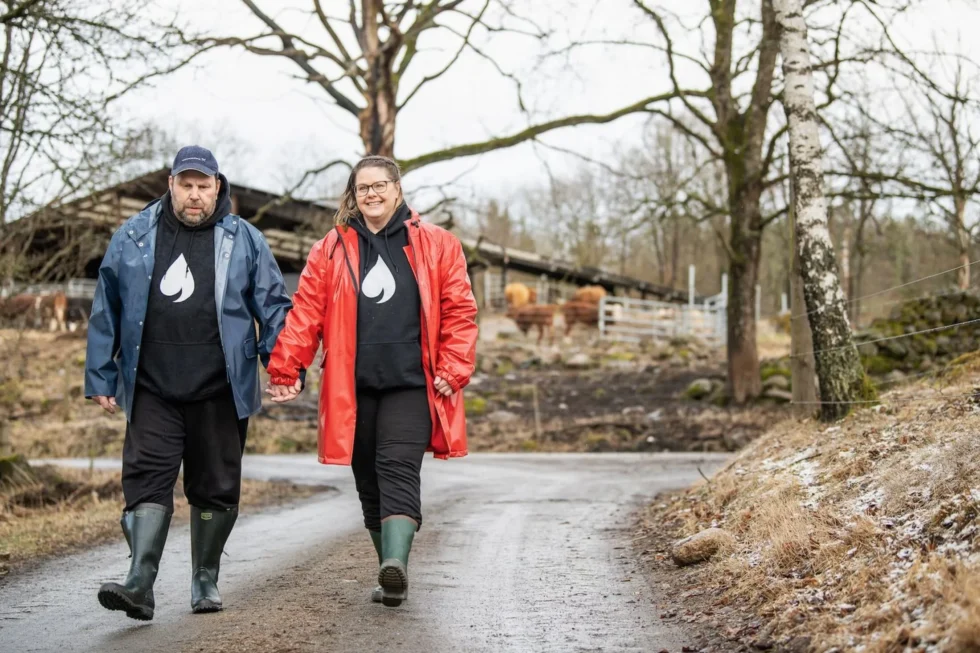
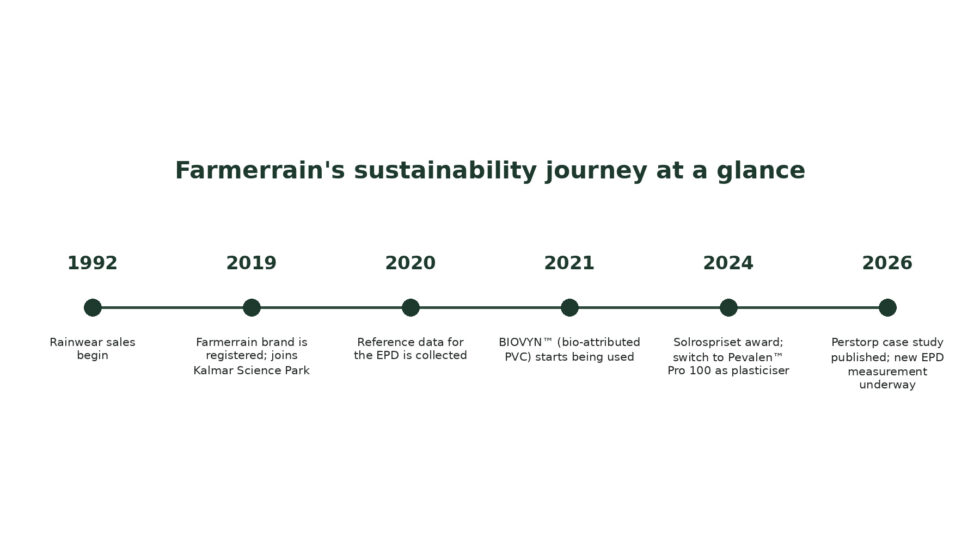
The rainwear sales that would become Farmerrain began as early as 1992. After a number of smaller changes, the Farmerrain brand (Svenska Regnkläds Aktiebolaget) was registered in 2019, the same year we joined Kalmar Science Park’s training programme for promising companies.
The milestones below are limited to dated, sourced events. We would rather build a timeline of facts we can stand behind than a curve of figures we cannot verify.
For us, sustainability is not a single campaign but an ongoing journey: we measure our environmental impact, act on the results and openly report both our progress and what remains to be done.
This page shows how: from the life cycle assessment that pinpointed where our greatest impact lies, through the material choices we have made in response, to how we concretely extend the life of every garment through repair, reuse and Deadstock.
We have had an independent life cycle assessment (LCA) carried out on our products. It showed that the single largest environmental impact lies in the raw material, particularly the PVC paste, and that a lighter fabric would lower the footprint in all measured categories. This is the starting point for the two measures we describe below: the switch to Biovinyl+ and the work on lighter fabric qualities.
Part of that basis is our own environmental product declaration (EPD) for the sailing jacket. An EPD is not marketing copy, but an independently reviewed life cycle assessment, produced according to established product category rules and verified by an external, accredited reviewer, in our case Sweco Environment. It is also time-limited and must be renewed, which is why a new measurement is already under way. We have not found any other rainwear brand we follow that has published a corresponding, third-party-verified EPD for a garment of its own. That is why we can state a specific figure such as 5.82 kg CO2e per jacket outright, rather than an estimate.
Our own Biovinyl+ responds directly to that finding. The PVC raw material BIOVYN™ is linked to renewable biomass through certified mass balance, and since 2024 we have used the plasticiser Pevalen™ Pro 100, which is completely phthalate-free and made from renewable or recycled carbon according to the same principle. The backing fabric in all our fabric qualities has also been made from 100 % recycled PET ever since Biovinyl+ was developed.
Our sailing jacket has a third-party-verified environmental product declaration (EPD-IES-0005125, reviewed by Sweco) of 5.82 kg CO2e per jacket, cradle to grave – but the figure is based on 2020 reference data, that is, before the switch to Pevalen. A new measurement is under way. According to Perstorp, the plasticiser has about 80 % lower carbon footprint (cradle to gate) than its fossil equivalent, and according to INOVYN, BIOVYN™ gives over 90 % lower greenhouse gas emissions than conventional PVC.
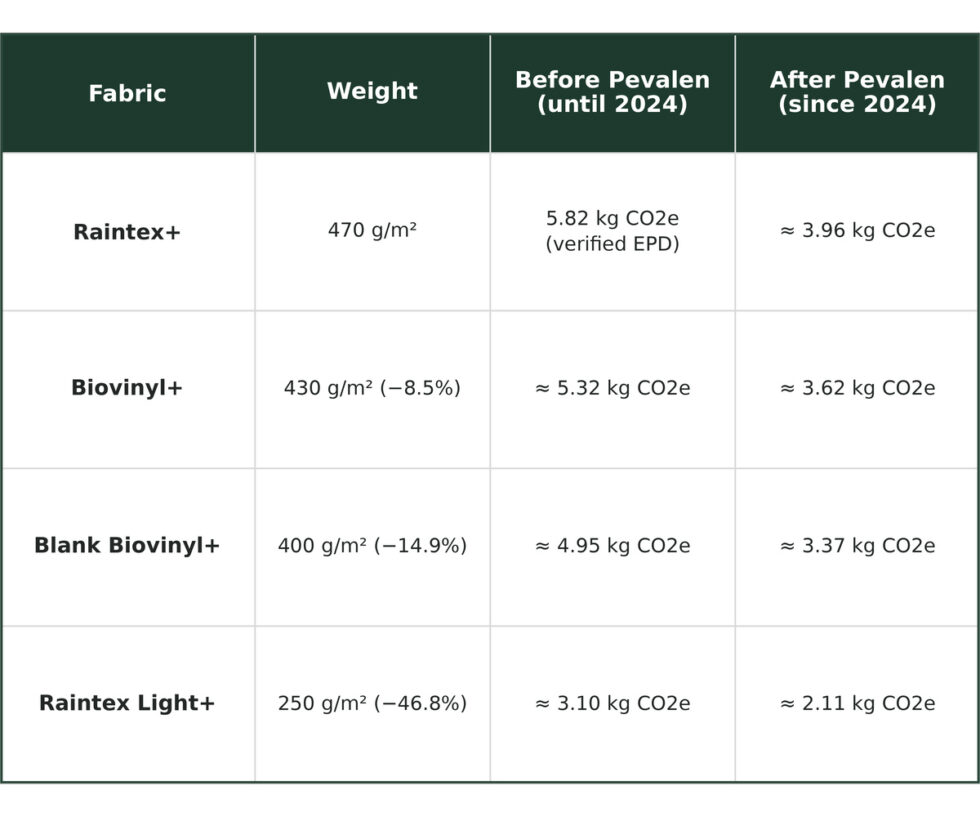
f you combine the plasticiser’s share of the footprint (about 40 %, our own calculation) with its own reduction (about 80 %), a calculation example arrives at roughly 4.0 kg CO2e (−32 %) for the jacket – an illustration, not a new verified EPD figure.
In addition to Raintex+ (470 g/m², the only fabric quality that has been EPD-measured), we offer three lighter qualities. Since the PVC paste is the dominant factor in the footprint, lower weight means a lower estimated footprint – see the table below. Only the Raintex+ figure “Before Pevalen” is a verified measurement; the others are calculation examples.