

-

Jacket Rasmus light Unisex Raintex Biovinyl+
€113 -

Jacket Flisan Unisex Biovinyl
€145 -

Jacket Rasmus Unisex Biovinyl+
€108 -

Jacket Vigra Unisex PVC
€99 -

Jacket Hunter Unisex Raintex Biovinyl+
€117 -
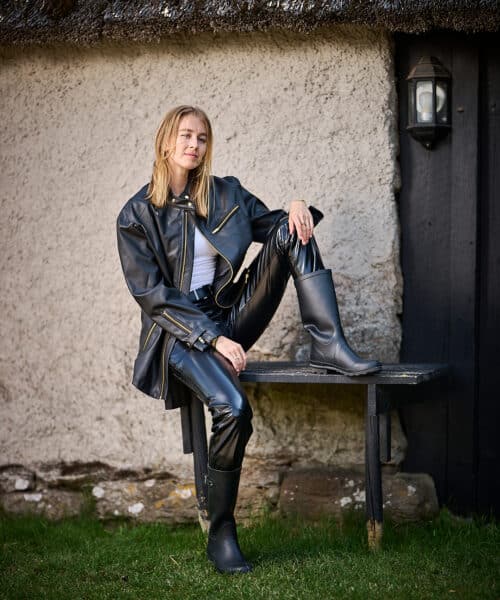
Jacket Biker Unisex Raintex Biovinyl+
€163 -

Sailing Jacket Cammo Unisex Raintex Biovinyl+
€113 -

Jacket Storm Unisex PVC
€117 -

Jacket Joha Unisex Biovinyl+
€117 -

Jacket Gutten Unisex Biovinyl+
€117 -

Jacket Three Pocket Cotton Classic Exlusive run Unisex Deadstock
€145


Before rubber and PVC existed, fishermen and sailors made their clothes waterproof by brushing
fabric with linseed oil in several layers. From the end of the 1700s, linseed oil was the most common
way of sealing both sails and clothes, and on the Swedish west coast many fishermen sewed their
own oilskins well into the 1900s.
Yes. We want your clothes to last as long as possible. That is why we can offer repair of your garment
to extend its lifespan. This can be done via our repair kits, button kits, or by it being sent to us for
welding and repair at the warehouse in Emmaboda, or being sent on to the factory. When the
garment has reached the end of its lifespan, we are happy to receive them in order to recycle / reuse
the material in the right way at the warehouse in Sweden / Emmaboda
Our rain jackets are designed in Sweden and made by hand in Poland.
Yes, all our rain jackets are unisex. The fit is straight and roomy to make space for layers underneath.
Compare the measurements in the size guide with a jacket you already have
Don’t wash unnecessarily — vinyl garments are easy to keep clean. Clean primarily with a damp cloth
and lukewarm water, without detergent. For more stubborn dirt, you can use uncoloured soap. If the
jacket needs machine washing, wash at 40 °C without fabric softener, ideally inside out. Never tumble
dry — let it air dry hanging instead. Creases can be gently ironed out at a low temperature from the
inside, with a cloth in between. Don’t store light-coloured, glossy garments against dark colours,
leather or faux leather, as they can transfer colour.
A rain jacket opens all the way down the front, whereas an anorak is pulled over the head. The rain
jacket is easier to take on and off and to air, and the anorak shuts out more wind and driving rain.
Farmerrain has both in Biovinyl+ with welded seams
A completely sealed material does not let out water vapour. When you exert yourself, moisture from
the body can therefore condense on the inside. That does not mean the jacket leaks. Unbutton at the
front, choose wool or other materials that handle moisture closest to the body, and hang the jacket so
that it can dry between uses. If you are often on the move you can choose a model with mechanical
ventilation. The Hunter jacket has vents on the chest and back, and the Adventure anorak has
ventilation in the back. Then the air gets out, but the rain stays out.
Yes. Our jackets in Biovinyl+ have a water column of over 20,000 mm and welded seams. Both the
material and the seams are thus completely sealed, and the jacket never needs to be reproofed
The anorak is older than both the zip and the raincoat. The word comes from the Greenlandic anoraq.
It was the Inuit garment for a life by the sea and on the ice, sewn from sealskin or reindeer skin. The
garment had no opening at the front and was pulled over the head. The reason was simple: where
there is no opening, the wind does not get in. The hood, the straight shape and the cord at the bottom
had the same purpose, to keep the warmth in and the weather out. The word and the shape reached
Europe in the early 1900s through the polar expeditions. Since then the anorak has accompanied
those who work and move outdoors, whatever the season.
The rain jacket has a different background. It comes from the harbours, where fishermen and sailors
made fabric waterproof with linseed oil, what was called oilskins. The fully buttoned front was quick to
take on and off and could be opened when the body got warm. That is still the rain jacket’s strength.
A rain jacket suits better when you often go in and out, want to dress in layers or need to be able to
open the jacket when you get warm. For rainy everyday days in town, a fully buttoned rain jacket is
often the most convenient choice
An anorak is pulled over the head and has a half zip, whereas a rain jacket is fully buttoned at the
front. The closed front makes the anorak more windproof and better at shutting out driving rain. The
rain jacket is easier to take on and off and to ventilate. Farmerrain has both, made in Biovinyl with
welded seams